

Risk of recurence

Risk on Standard of Care (SoC)

Despite ET, the risk of recurrence is substantial in HR+/HER2– EBC. (1)

Despite SoC, there is an unmet need in HR+/HER2– EBC, with patients facing the risk of an incurable recurrence. (1,2)

Adapted from Fasching PA, et al., 2024 and Harbeck N, et al, 2019. (1,2)

* After 4 years, the majority of iDFS events were distant recurrences, which were more common in the AI alone group (9.6%, n=246). (1)

Risk by Nodal Status

Risk of metastatic recurrence remains regardless of ET or nodal status in ER+ BC. (1)

In recent decades, treatment advances have reduced the risk of metastatic recurrence.
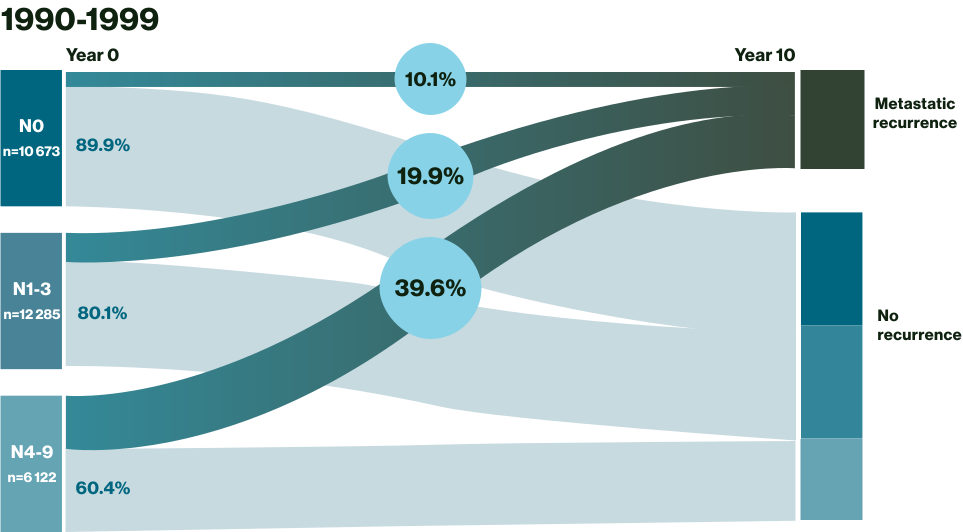
Diagram illustrating the risk of metastatic recurrence in ER+ breast cancer based on nodal status from 1990 to 1999. The timeline spans from diagnosis (Year 0) to 10 years post-diagnosis (Year 10). On the left, patients are categorized into three groups based on the number of affected lymph nodes: N0 (no nodes affected, n=10673), N1–3 (1–3 nodes affected, n=12285), N4–9 (4–9 nodes affected, n=6122). On the right, the graph shows the proportion of patients who experienced metastatic recurrence versus those who did not by Year 10. Recurrence rates increase with the number of nodes affected: 10.1% for N0, 19.9% for N1–3, and 39.6% for N4–9. The diagram emphasizes that despite treatment advances, the risk of metastatic recurrence persists across all nodal status groups.

← Slide to view more →

Yet the risk of metastatic recurrence remains regardless of ET or nodal status
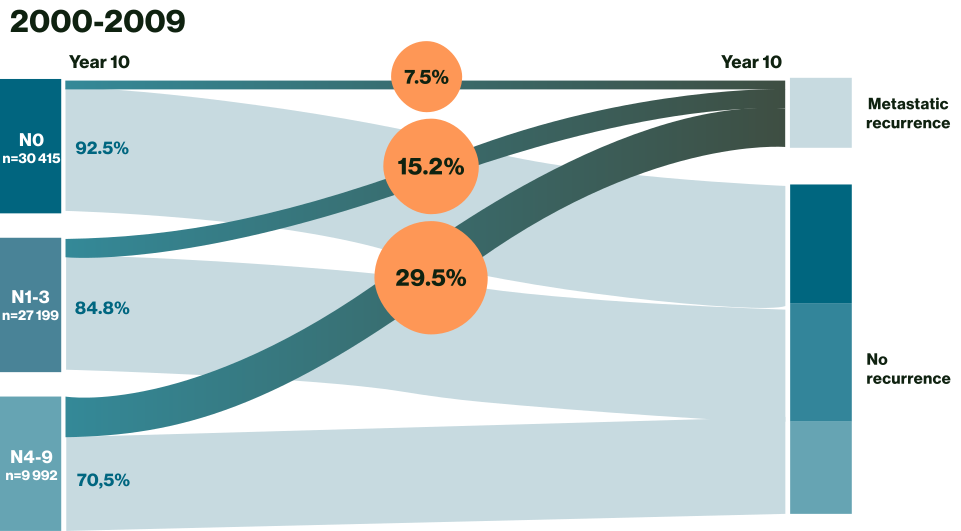
Diagram illustrating the risk of metastatic recurrence in ER+ breast cancer based on nodal status for patients diagnosed between 2000 and 2009. The flow diagram shows outcomes 10 years after diagnosis. On the left, patients are grouped by nodal involvement: N0 (no nodes affected, n=30415), N1–3 (1–3 nodes affected, n=27199), N4–9 (4–9 nodes affected, n=9992). On the right, the proportions of patients with and without recurrence are represented. By Year 10, metastatic recurrence occurred in 7.5% of N0 patients, 15.2% of N1–3 patients, and 29.5% of N4–9 patients. The diagram reflects a reduced overall risk compared to earlier decades, though recurrence risk remains strongly associated with nodal status.

← Slide to view more →

Pooled analysis of 155,746 women with ER+ or ER– BC in 151 RCTs enrolled 1990–2009. Patients had received ≥5 years ET, were <75 years at diagnosis, had tumour diameter ≤5.0 cm, <10 positive axillary lymph nodes, and no evidence of distant metastasis. Primary outcome was time to first distant recurrence. (1)

By Novartis AG
© 2025 ǀ FA-11471125-2 ǀ October 2025

Use of this website is subject to our Terms of Use